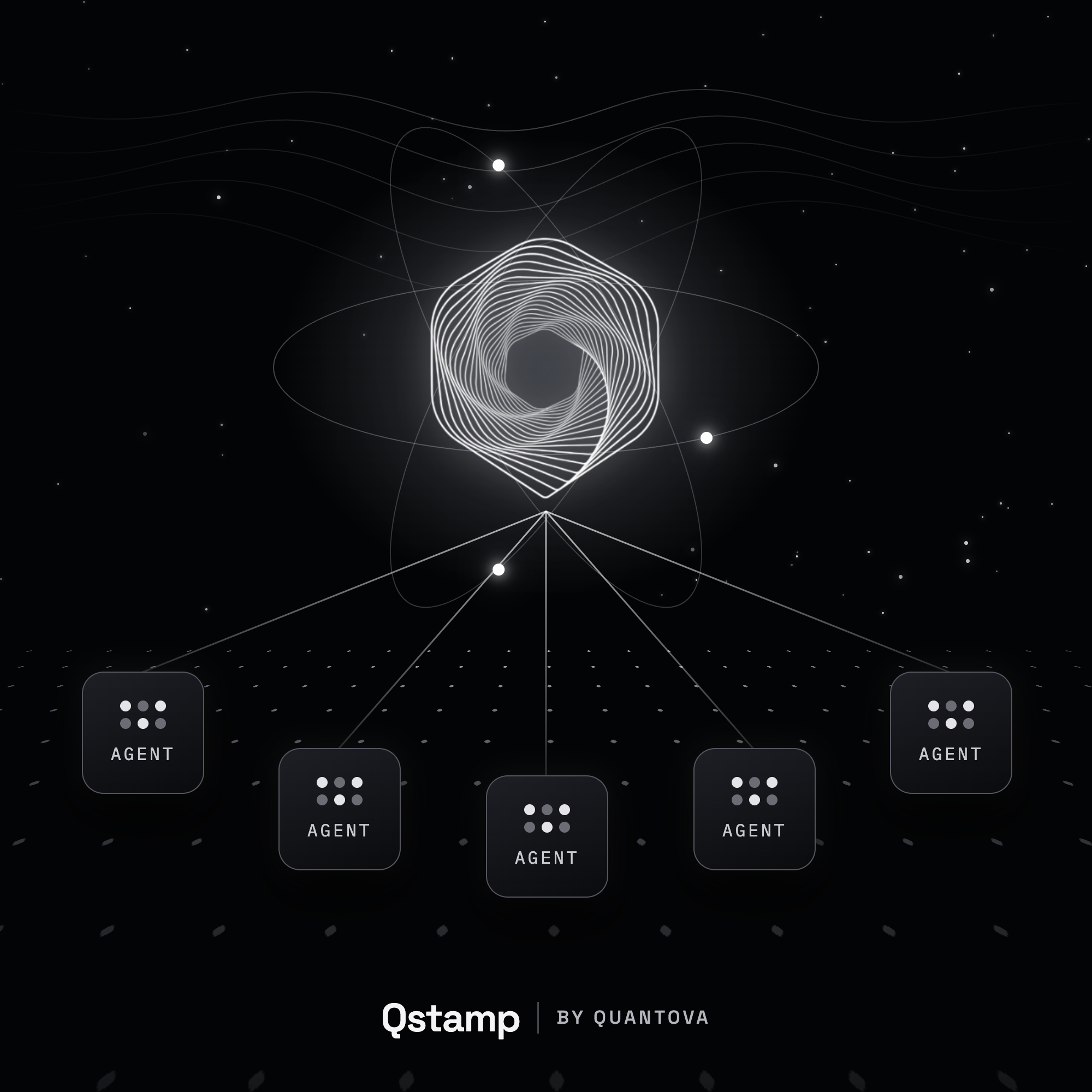
Quantova launches the Qstamp family, a post quantum evidence toolbox for AI agents, banks and government records
Built on its own ledger, contract language and compiler, Quantova�s 12 open source SDKs let institutions prove what an AI agent did without sharing the data.
Wilmington, Delaware, United States – Friday, October 16, 2026
An AI agent that approves a payment today may have to prove that decision after 2035, when United States policy aims to retire quantum vulnerable cryptography. Quantova Inc�s Qstamp family, downloaded 10,482 times on npm by 12 October 2026, records each agent action as a fingerprint signed with ML-DSA-65 under FIPS 204.
Why the timing matters
Article 12 of the EU AI Act requires high risk AI systems to record events automatically over their lifetime. National Security Memorandum 10 sets the 2035 goal, and NIST draft IR 8547 proposes disallowing RSA and elliptic curve signatures thereafter.
A stack without classical signatures
Rather than add post quantum signatures to an existing system, Quantova built one without classical public key cryptography. Its Q-Crypto library implements ML-DSA, ML-KEM, SLH-DSA and SHA-3 on the Rust standard library alone, and a deny list bars every elliptic curve and RSA package. Quanta, Quantova�s contract language and compiler, refuses to compile reentrancy, overflow, forged authorisation and front running. It compiles to the Quantova Virtual Machine, which verifies post quantum signatures natively. The public ledger has signed every transaction and block with ML-DSA-65 since its first block. A separate private network for banks and governments runs ML-DSA-87 and ML-KEM-1024, the algorithms the NSA selected for CNSA 2.0.
Live and ready to use
All 12 SDKs are live and ready to use today. Qstamp runs on the organisation�s own servers and only a salted SHA3-256 commitment leaves, so no record or personal data reaches Quantova. Anchors are final in about 0.2 seconds and verifiable by any regulator holding the record and receipt. QMandate binds agents to signed limits, QLog proves intent preceded action and six QGov SDKs cover tax, spending, procurement and elections. The SDKs use NIST approved algorithms and support Article 12 record keeping. Quantova is pursuing further government validation. Its public fixes for Ethereum, the XRP Ledger, BNB Chain, Cardano, Sui and NEAR are at Quantova�s GitHub.
( Press Release Image: https://photos.webwire.com/prmedia/106076/362933/362933-1.png )